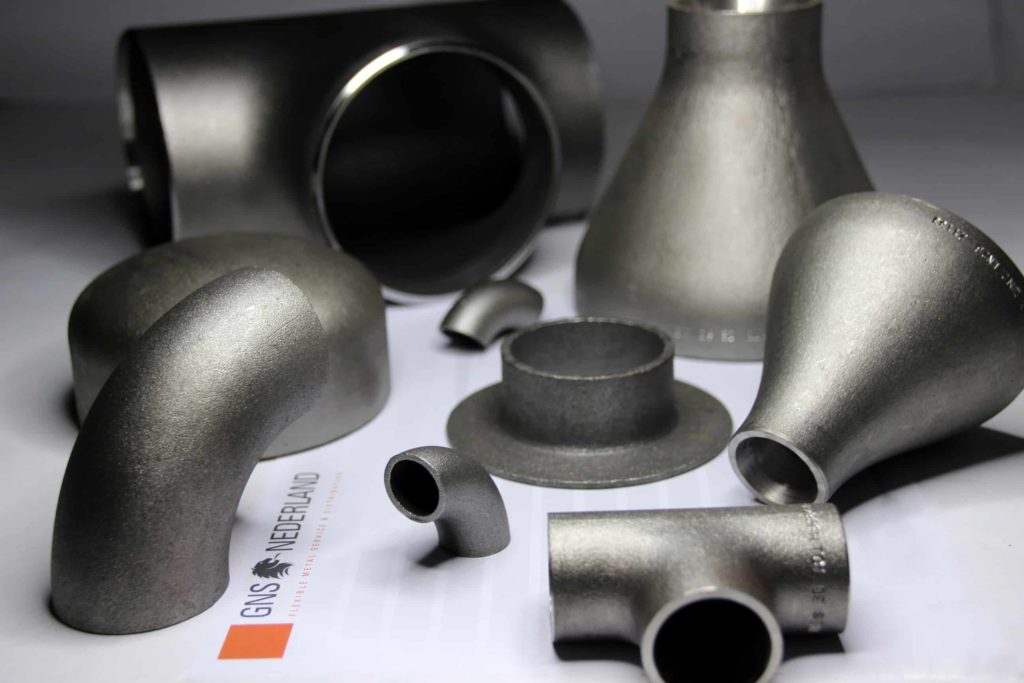
Fittings according to EN 10253-4, types A and B. The differences
02 February 2025
Butt weld steel elbows, reducers, caps and tees according to EN10253-2 are available in two versions (Type A and B). The difference lies in the minimum wall thickness at various points on the fitting.
For type A, the wall thickness (up to a diameter of 610) may be a maximum of 12.5% thinner than the nominal thickness. This therefore applies to both the ends and other parts of the fitting.
For type B fittings, the wall thickness at all points (including the bends) must be at least the nominal thickness of the welded ends. To achieve this, type B fittings are manufactured from raw material with a much greater wall thickness. In this way, the minimum wall thickness can be achieved at all points of the fitting. Any excess wall thickness at the welding ends is turned down to match the wall thickness of the pipe.
Consequences for the permissible pressure.
Type A fittings have (due to the permitted thinner wall) a lower maximum pressure rating than those of type B. For type B, the maximum pressure rating of the corresponding pipe of the same grade may be used.
To determine the permissible pressure, the maximum pressure ratings of Type B fittings must – in some cases – be reduced. This reduction varies depending on the fitting, size and wall thickness. The example below illustrates the differences for size 76.1 with various wall thicknesses and types of fittings.
Steel fitting EN10253-2 type A: Allowed pressure:
Butt weld tee 76.1 x 2.9 mm 34% of type B
Butt weld tee 76.1 x 8 mm 47% of type B
_________________________________________________________________________________
Butt weld elbow 76.1 x 2.9 mm 88% of type B
Butt weld elbow 76.1 x 8 mm 89% of type B
_________________________________________________________________________________
Butt weld concentric reducer 76.1 x 33.7 x 2.9 x 2.9 mm 100% of type B
Butt weld concentric reducer 76.1 x 33.7 x 8.0 x 5.6 mm 100% of type B
_________________________________________________________________________________
Butt weld eccentric reducer 76.1 x 33.7 x 2.9 x 2.6 mm 90% of type B
Butt weld eccentric reducer 76.1 x 33.7 x 8.0 x 5.6 mm 100% of type B
The example above clearly shows that the largest correction must be applied to tees and the smallest to reducers. It can also be seen that as the nominal wall thickness increases, the difference in pressure becomes smaller or even equal to type B.
Would you like more information about the correction for other dimensions? Call us on +31 40 368 22 70 or click here to email us your question.
Despite the care taken in compiling the above article, we do not guarantee its accuracy.