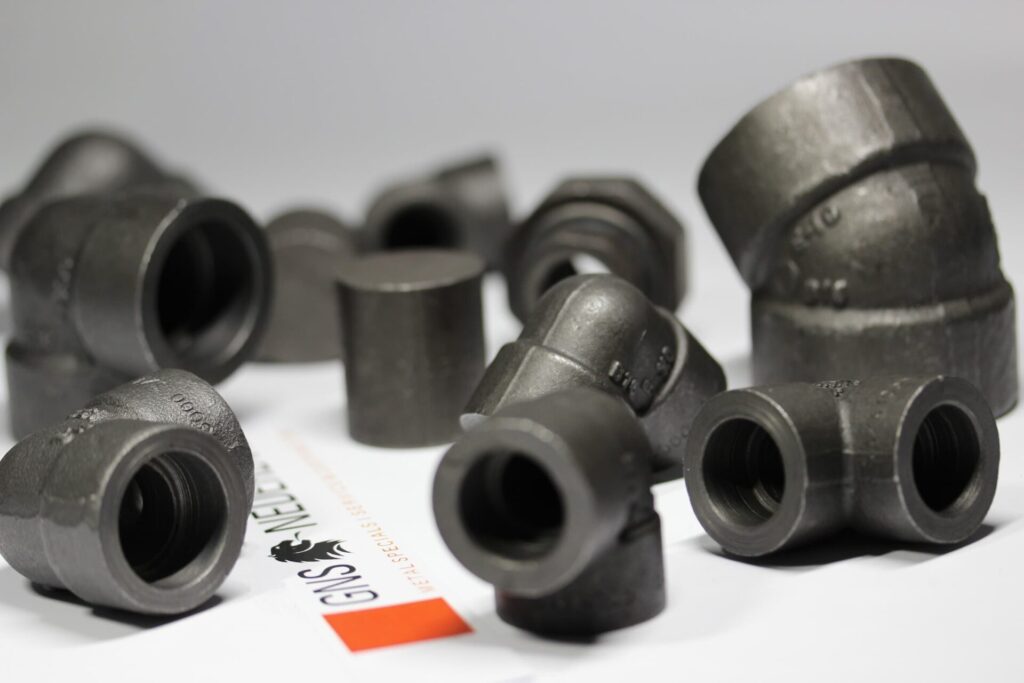
Expansion range steel socket weld fittings in 3000–6000 lbs
27 March 2026
GNS has further expanded its range with a complete line of forged steel socket weld (SW) fittings in 3000 and 6000 lbs. These socket weld fittings are now available in both ASTM A105 and the alloyed grade A350. This move responds to the growing demand for high-quality fittings for applications where material performance and reliability are essential.
In addition to A105, GNS now also supplies fittings in the A350 LF2 and LF3 grades. Both versions are suitable for low-temperature applications.
- LF2 is a low-temperature carbon steel suitable for temperatures down to approximately –46 °C.
- LF3 contains 3.5% nickel, which makes it much tougher at extremely low temperatures down to –101 °C.
The main differences:
1. Chemical composition
- LF2
- Carbon ≤ 0.30%
- Manganese 0.60–1.35%
- Low nickel content (max 0.4%)
- LF3
- Carbon ≤ 0.20% (lower than in LF2 → better weldability)
- Manganese 0.90–1.35%
- Nickel 3.3–3.7%
The nickel content makes the difference here: nickel increases toughness at very low temperatures.
2. Mechanical properties
- Tensile strength and yield strength are comparable.
- Impact toughness values (Charpy V-notch):
- LF2: tested at –46 °C
LF3: tested at –101 °C
- LF2: tested at –46 °C
Due to its higher nickel content, LF3 remains tough at much lower temperatures.
Available in elbows, tees, (half) couplings, unions, reducing couplings, welding bosses and reducing inserts.
All products are sourced from reputable Western European manufacturers, ensuring consistent quality, dimensional accuracy, high-quality finish and full traceability.
Interested in the possibilities? Call us on +31 40 368 22 70 or click here to email us. View our range of high-pressure fittings here.
Technical specifications
- Material grades: ASTM A105, A350 LF2/LF3.
- Pressure classes: 3000 lbs and 6000 lbs.
- Manufacturing: forged for maximum strength by retaining the structure.
- Connection: socket weld (insertion), ideal for high pressure, vibration loads and critical process environments.
- Material certificates in accordance with EN10204/3.1.
- Applications: petrochemicals, energy, offshore, mechanical engineering and process industry.
Advantages of high-pressure socket weld fittings compared to threaded fittings:
1. Stronger and more reliable connection
Socket-weld fittings are welded and therefore provide a much stronger, vibration-resistant connection than threaded fittings. Ideal for high-pressure and dynamic systems.
2. Lower risk of leakage
Threaded fittings always have a potential leak path along the thread. Socket-weld connections are fully welded shut and are therefore better suited to critical process environments.
3. Better resistance to high temperatures
Threads can deform with temperature fluctuations. Welded socket-weld connections retain their integrity at higher temperatures.
4. Smoother internal flow
Thread grooves cause turbulence and debris accumulation. Socket-weld fittings have a smooth bore, ideal for steam, condensate, instrumentation lines and clean media.
5. Better alignment and installation
The socket acts as a guide, ensuring the pipe is automatically positioned correctly. Less dependent on craftsmanship than threaded connections.
6. Suitable for corrosive or critical media
No threads means no crevice corrosion. Widely used in petrochemicals, energy, offshore and high-pressure systems.
Despite the care taken in compiling the above article, we do not guarantee its accuracy.