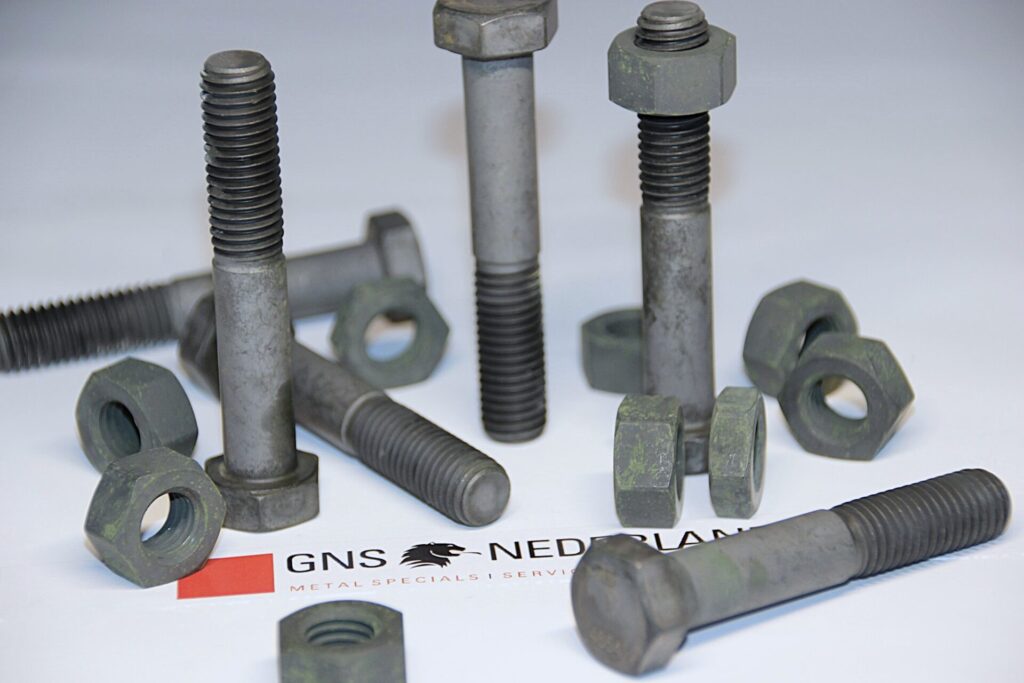
Waspaloy: quality bolts and nuts for high temperatures
09 September 2026
GNS Nederland recently supplied a company located at Chemelot in Geleen with various DIN 931 bolts and nuts in Waspaloy (UNS N07001 / 2.4654). This uncommon grade proved more difficult for our customer to source than initially expected.
The search eventually ended in Eindhoven.
GNS arranged for the bolts and nuts to be manufactured within the EU, using European-origin raw material. Naturally, they were supplied with the required EN 10204 material certificates and delivered within the agreed lead time.
A promise is a promise.
About Waspaloy
Waspaloy is a nickel-based, precipitation-hardening superalloy with excellent high-temperature strength and good resistance to corrosion, particularly oxidation. This makes Waspaloy particularly well suited to applications where high mechanical loads and elevated temperatures occur simultaneously.
The excellent high-temperature properties of Waspaloy result from a combination of alloying elements. Molybdenum (Mo), cobalt (Co) and chromium (Cr) contribute to its strength and resistance to the environment at elevated temperatures. Aluminium (Al) and titanium (Ti) play an important role in precipitation hardening by contributing to the formation of the strengthening γ′ phase (nickel-aluminium-titanium), which gives Waspaloy its high strength.
Heat treatment
To achieve its final mechanical properties, Waspaloy undergoes a carefully controlled heat treatment. This consists of a solution treatment, followed by stabilisation and precipitation hardening (age hardening).
Depending on the required properties and application, the exact heat treatment may vary. A typical treatment consists of a solution treatment at approximately 1020–1080 °C, followed by stabilisation at around 845 °C and subsequent precipitation hardening at around 760 °C.
During precipitation hardening, very fine strengthening precipitates form within the microstructure. This significantly increases the hardness and strength of the material. At the same time, a small dimensional change may occur.
For this reason, the final heat treatment is generally planned in conjunction with the stage at which the component must achieve its final dimensions and properties. Machining after the complete ageing treatment can also be considerably more difficult due to the increased hardness.
Applications of Waspaloy
Waspaloy is widely used in environments where high-temperature strength, creep strength and oxidation resistance are important. The material is used, among other things, for gas turbine components, including rotor discs, shafts, spacers, seals, rings and other critical components. Fasteners are another important application.
For critical rotating applications, Waspaloy is generally used at temperatures of up to approximately 650 °C. For other, less demanding applications, the material can be used at temperatures of up to approximately 870 °C, depending on the load and the specific application.
It is precisely the combination of high-temperature strength, oxidation resistance and corrosion resistance that makes Waspaloy an attractive material for highly demanding industrial applications.
Waspaloy fasteners from GNS
GNS Nederland supplies a complete range of corrosion- and heat-resistant fasteners, including Waspaloy. Click here for our assortment.
Would you like to know more about the possibilities?
Call us on +31 40 368 22 70 or click here to email us with your enquiry.